The Power of the Notebook
“I’ve been getting into writing a lot of short fiction. I call them ‘to do lists’.” (@Anomnomnomaly@beige.party on Mastodon via DenseDiscovery)
This above comment really resonated with me when I read it because that was how I felt for years. I bought all sorts of apps with fancy email and on screen alerts to remind me to action my to-do list. I would simply silence the alerts and carry on not getting things done. A decade ago I decided to go back to analogue note-taking and bought myself a notebook. I don’t recall exactly when after that I started writing down my to-do list in my notebooks but something miraculous occurred: ticks started appearing next to the tasks listed. I was actually completing the tasks! I’d find myself wondering what I need to do next, I’d pick up my notebook to find it staring at me in my barely legible handwriting. Seriously, my handwriting is not only illegible but to use my siblings’ word, it is ugly. How could it have been so effective in getting me to complete my to-do-list? And I’ve kept it up since? I’m only writing this post because my notebook told me to do it! When I first came across the book The Notebook: A History of Thinking on Paper, it dawned on me that I knew nothing about this thing called the notebook. I thought the book might be able to tell me why the notebook (along with my scribbling) succeeded where many beautifully and thoughtfully designed to-do-list tools failed.
The first known notebook was discovered from the oldest shipwreck yet excavated in Ulu Burun, Turkey, that went down around 1304 BCE. It is in the form of a diptych that would fit into the palm of the hand. The diptych would have been made from recesses cut into two boxwood leaves and filled with a layer of soft beeswax, to write with a stylus. When they needed to reuse the diptych, its wax could be smoothed over again. It is assumed that based on the size of the diptych it was most likely used for things like a to-do list, the draft of a letter or a phrase to remember (Allen, Roland. The Notebook: A History of Thinking on Paper (p. 21)). The next known notebook format after the diptych was the codex invented by Romans in 80 CE, made of pages of papyrus bound together inside a protective parchment cover called the Codex. The paper form was invented in China in the early 2nd century, and is said to have made its way to what is now known as the Middle East around 800 CE. For the following four centuries, paper enabled Persian, Arabic and other Muslim intellectuals to race ahead of their rivals and counterparts in Christian Europe. Islamic cities boasted million-volume libraries and streets of booksellers: administrators, students, teachers, and thinkers of all kinds relied on relatively cheap, plentiful paper to do their work (Allen, Roland. The Notebook: A History of Thinking on Paper (p. 27)).
Paper notebooks arrived in Europe in the 13th century, and had a transformative impact. For example, their use by Italians merchants to keep trade ledgers led to the creation of double-entry accounting by Amatino Manucci. The same method is still used today, as is the twelve calendar months-financial year he created. Manucci’s invention didn’t spread to the rest of Europe until a couple of centuries later thanks to another fervent Italian notebook keeper by the name of Luca Pacioli. Pacioli published the book Summa de Arithmetica to share his research and knowledge of European mathematics that he had spent years recording in his notebooks. Included in the book was a whole section, offering a practical guide to applying Manucci’s double-entry accounting which he believed was the best way to run a business. And “without double entry, businessmen would not sleep easily at night. Their minds would keep them awake with worry.”(Allen, Roland. The Notebook: A History of Thinking on Paper (p. 106)). Pacioli also added instruction in good practice in letter-writing, record-keeping, filing – and even that staple of the workplace notebook, the things-to-do list. (Allen, Roland. The Notebook: A History of Thinking on Paper (p. 107)). After this, the topic of using a notebook for a to-do-list didn’t come up again until Roland Allen got to the 21st century, towards the end of the book, where he talks about Bullet Journaling. This is a method developed by Ryder Carroll who suffers from ADHD. Carroll, in his quest to get his life organised, discovered that he could use his notebook to take notes about things he wanted to remember, brainstorm and list future tasks using concise bullet points categorized according to their purpose. I recalled that I had read about Bullet Journaling before. I didn’t get it then and I still don’t get it after reading about it in Allen’s book. Nevertheless, it seems to have worked for Carroll so much so that he created a company selling Bullet journals.
Once I got to the end of the book, I reflected on all that I had learnt about the notebook. I found it interesting to read about all the different ways in which the paper based notebook has been used since its arrival in Europe in the 13th century to the current time. I asked if it had answered the question that drew me to it: How could a notebook have been so effective in getting me to do my to-do-list? My initial response was no. Later, I realised that it did answer me. To see all the different ways the notebook has been used tells me that its power lies in that you can use it however you want. You can use the notebook to understand a complex system such as the human anatomy and then use it to create masterpieces of art as Leonardo Da Vinci did. Darwin helped construct the foundation of evolutionary biology thanks to the observations he made and recorded in copious notebooks while traveling through South America. This resulted in his seminal work, On the Origins of Species. You can use the notebook to heal others. Hospitals in the UK and Denmark discovered that giving patients handwritten notebooks of events that happen while they were in the intensive care unit can help to reduce PTSD by up to 60% (Allen, Roland. The Notebook: A History of Thinking on Paper (p. 253)).
Since I finished the book, I’ve been wondering if I hadn’t been underutilising my notebook. I now keep it closer to me, should inspiration occur.
Factfulness
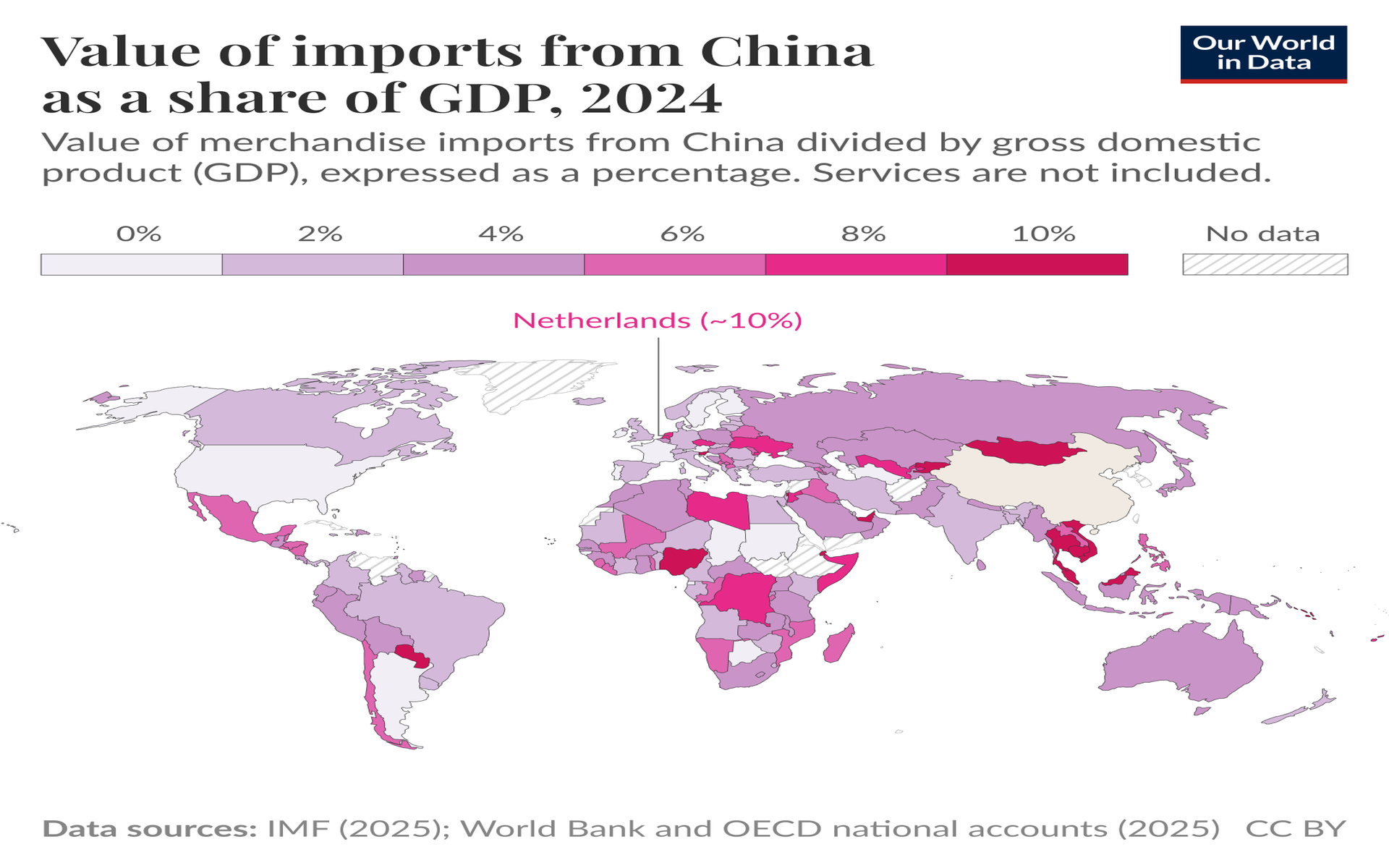
“Everything is made in China!” “We get everything from China.”
It is true that China is the top source of imported merchandise for many countries, the no.1 source for 40% of countries worldwide. However, in most countries imports from China are less than 10% of their GDP. So not everything is imported from China.